Description
GHK-Cu is the naturally occurring tripeptide glycyl-L-histidyl-L-lysine coordinated to copper(II). It has the longest and most mainstream research history of anything in this catalogue, and almost all of it sits in topical and cosmetic science.
What you are buying
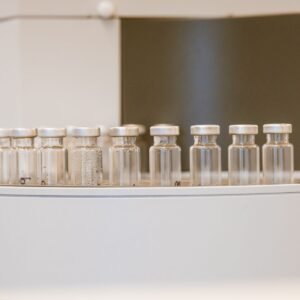
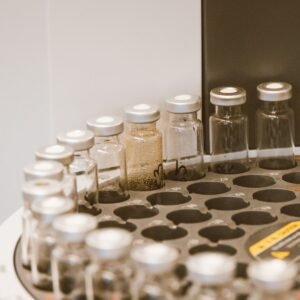
A single 50 mg vial of lyophilised GHK-Cu from batch VL-2712-A, supplied as a research reagent for formulation and laboratory work. The certificate of analysis is published in full, including identity confirmation and copper-complex purity by RP-HPLC.
Topical research context
GHK-Cu has a long documented history as a cosmetic ingredient and a substantial published literature in topical and skin-model research — fibroblast culture, reconstructed skin models, and controlled topical studies assessing cosmetic endpoints such as skin density and roughness.
We present it in that context deliberately, because that is where the credible evidence sits. Our topical versus injectable page explains the reasoning openly rather than leaving you to infer it.
Formulation notes
Nearly every practical constraint follows from the copper, not the peptide. The complex is pH sensitive, incompatible with strong reducing agents such as ascorbic acid, and can be stripped by chelating agents like EDTA. It is also intensely blue, which is both a formulation constraint and a useful integrity indicator.
The formulation guide covers pH ranges, incompatibilities, colour as a stability proxy, and what a stability programme for a copper complex should actually track.
Handling
Store lyophilised at −20 °C, sealed and protected from light. Prepare aqueous stocks fresh where possible; if stored, keep refrigerated and protected from light, and check colour before use — loss of blue indicates the complex is dissociating.
Supplied as a research reagent only. This is not a cosmetic product and not a finished formulation.