BPC-157 storage and reconstitution
How to store, reconstitute and aliquot lyophilised BPC-157 for laboratory work, and the handling variables that most affect stock integrity.
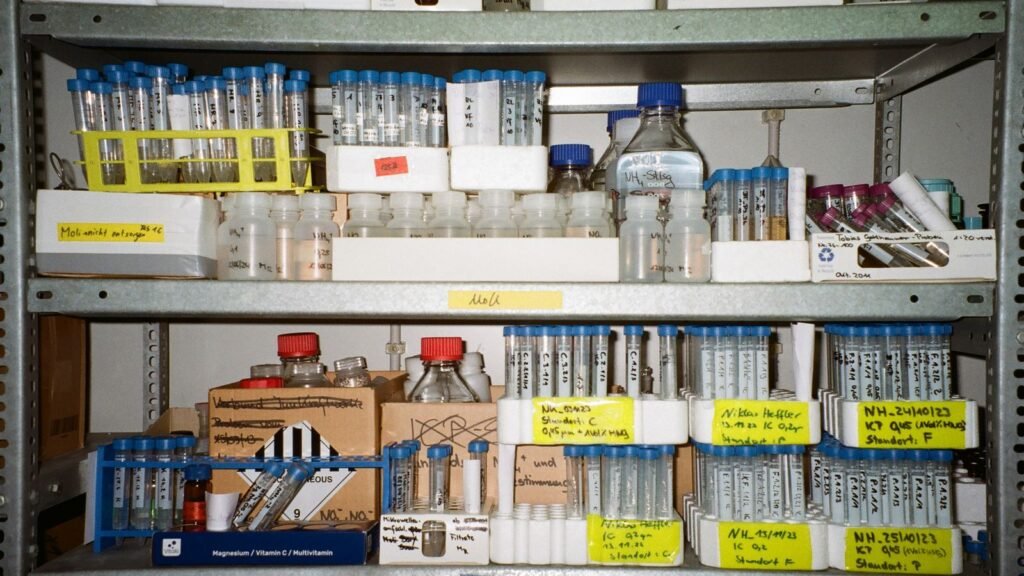
This describes laboratory handling of a research reagent — preparing and storing a stock solution for in vitro work. It is not a preparation guide for administration to any person or animal, and no such use is permitted.
Storage of lyophilised material
As supplied, BPC-157 is a lyophilised powder. Lyophilised peptide is considerably more stable than peptide in solution, so material should be kept in that state until it is needed.
| State | Temperature | Notes |
|---|---|---|
| Lyophilised, long term | −20 °C | Protect from light and moisture. Allow to reach room temperature before opening. |
| Lyophilised, short term | 2–8 °C | Acceptable for weeks rather than months. |
| In solution | 2–8 °C | Days. Peptides in aqueous solution degrade far faster than lyophilised powder. |
| In solution, frozen aliquots | −20 °C or below | Preferred for anything beyond immediate use. Avoid repeated freeze–thaw. |
Let a cold vial equilibrate to room temperature before breaking the seal. Opening a cold vial draws in humid air, and condensation onto lyophilised powder begins hydrolysis before you have added any solvent at all.
Solvent selection
BPC-157 is generally soluble in aqueous solvent. Sterile or bacteriostatic water is the usual laboratory choice for preparing an aqueous stock. Bacteriostatic water contains a preservative, which is relevant if a stock will be accessed repeatedly over time.
Where a peptide is poorly soluble, a small volume of an appropriate organic co-solvent followed by dilution into aqueous buffer is a standard approach — but this should be established for the specific application rather than assumed, and co-solvent compatibility with the downstream assay must be checked.
Calculating stock concentration
Concentration follows directly from vial mass and solvent volume. For a 5 mg vial:
| Solvent added | Resulting concentration |
|---|---|
| 1 mL | 5 mg/mL |
| 2 mL | 2.5 mg/mL |
| 5 mL | 1 mg/mL |
Vial mass is not the same as peptide mass. Water content and acetate counter-ion make up part of the total, which is exactly why we publish both figures on every certificate. For our current batch those are 4.2% and 7.8% respectively — factor them in if your work requires accurate molar concentration.
Reconstitution technique
- Equilibrate the vial to room temperature.
- Disinfect the stopper and allow it to dry.
- Add solvent slowly, directing the stream against the inner wall of the vial rather than onto the powder cake directly.
- Allow the cake to dissolve without agitation. Do not shake — mechanical shear and foaming both degrade peptides.
- If dissolution is slow, swirl gently or leave at 2–8 °C for a short period.
- Inspect: a correctly reconstituted solution should be clear and free of visible particulates.
Aliquoting and freeze–thaw
Freeze–thaw cycling is the single most avoidable cause of stock degradation. Divide the reconstituted stock into single-use aliquots immediately, in low-binding tubes, and freeze them. Thaw only what a given experiment requires.
Label every aliquot with compound, batch number, concentration, solvent and date. The batch number matters: it is what links your stock back to a specific certificate of analysis.
Frequently asked questions
How long is reconstituted BPC-157 stable?
It depends on solvent, temperature, concentration and freeze–thaw history, so no single figure applies. Refrigerated aqueous stocks are generally treated as short-lived; frozen single-use aliquots are the standard approach for longer storage.
Why not shake the vial to speed dissolution?
Shaking introduces mechanical shear and foaming at the air–liquid interface, both of which promote peptide degradation and aggregation. Gentle swirling and patience are better.
Does the certificate's purity figure still apply after reconstitution?
The certificate describes the material as supplied. Once reconstituted, stability is governed by your handling and storage, and the certificate makes no statement about it.