Every batch. Tested, verified, published.
No batch is released for sale until an independent laboratory has confirmed its identity and measured its purity, and the resulting certificate is published on this site.
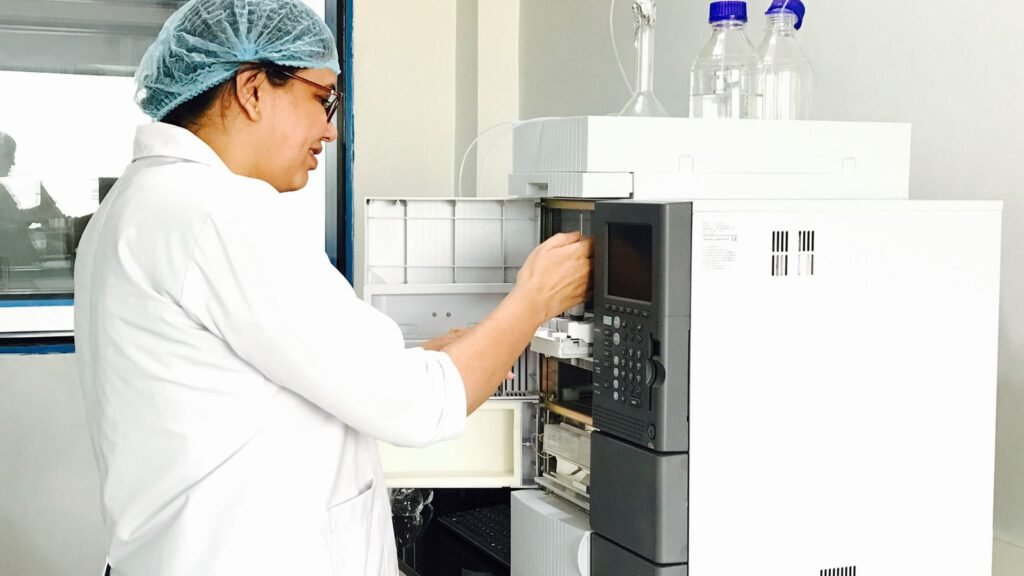
From supplier to released batch
Incoming batch quarantine
Material arrives and is held. Nothing is listed, photographed or made purchasable while a batch is in quarantine.
Sampling
Vials are drawn at random from across the batch rather than from the top of the carton, and sent to the testing laboratory under our own reference number.
Identity confirmation
Mass spectrometry confirms the observed molecular weight matches the expected value for the declared sequence. A purity figure means nothing if the compound is not what it claims to be, so identity is confirmed first.
Purity by HPLC
Reversed-phase HPLC with UV detection quantifies the main peak as a percentage of total peak area, and resolves related substances.
Supporting assays
Water content by Karl Fischer titration, acetate content by ion chromatography, and bacterial endotoxin by LAL. These are the figures most commonly omitted elsewhere.
Release and publication
If every parameter is within specification, the batch is released and the certificate is published here before the product page goes live. If it is not, the batch is rejected and never listed.
What each test measures
| Parameter | Method | What it tells you |
|---|---|---|
| Identity | LC-MS (ESI+) | Whether the observed molecular weight matches the declared sequence. |
| Purity | RP-HPLC, UV 214 nm | Main peak as a percentage of total peak area. |
| Related substances | RP-HPLC | Individual impurities resolved from the main peak. |
| Water content | Karl Fischer titration | Residual moisture in the lyophilised powder, which affects stated mass. |
| Acetate content | Ion chromatography | Counter-ion load — part of the vial mass that is not peptide. |
| Bacterial endotoxin | LAL, kinetic chromogenic | Endotoxin burden, expressed in EU per milligram. |
| Appearance | Visual inspection | Cake condition and colour, checked against the expected description. |
A purity percentage is only meaningful alongside the method that produced it, the wavelength, and the identity confirmation that preceded it. A figure quoted without those is not a result — it is a number. Every certificate we publish carries all four.
Current batches
Each certificate stays online after a batch is superseded, so a vial bought a year ago still resolves to its own document.
Frequently asked questions
Who performs the testing?
An independent analytical laboratory contracted directly by Verolyn Labs, with no commercial relationship to the manufacturer of the material. The laboratory is named on every certificate.
Do you accept a supplier's own certificate?
No. A supplier certificate may accompany incoming material, but it does not substitute for our own testing and it is not what we publish.
What happens when a batch fails specification?
It is rejected and never listed. Failed batches are not reworked, blended into passing stock, or sold at a discount.
Why publish water and acetate content?
Because both are part of the vial mass that is not peptide. A vial can be 99% pure by HPLC and still contain meaningfully less peptide than the label mass implies if water and counter-ion are high. Publishing them lets a researcher work out actual peptide content.
Can I get the raw chromatogram?
Yes. Write to research@verolynlabs.com with the batch number and we will send the full analytical report as issued by the laboratory.